 Skip to content

What Is AI? A Simple Guide for Busy Professionals
Artificial Intelligence (AI) is one of the most talked-about topics in business today, but for many professionals it still feels unclear or overly technical. If you’ve ever asked yourself “What exactly is AI, and how does it matter to me?”—you’re not alone.
In simple terms, AI is technology designed to learn from data, spot patterns, and make decisions or recommendations—just like a helpful assistant who gets better over time. In practice, AI is the engine behind everyday things you probably already use: when your email filters spam, when maps reroute around traffic, or when your phone predicts your next word.
This guide breaks down AI in plain English: what it is, how it works, and why it matters for professionals today. You’ll leave with clarity—and a first step toward building AI confidence.
Table of Contents
What Is AI?
AI, or Artificial Intelligence, refers to systems that can perform tasks that typically require human intelligence—such as recognizing language, analyzing data, or making predictions. It’s just software.
Think of AI as software that doesn’t just follow instructions—it learns, adapts, and improves as it processes more information.
How AI Works in Simple Terms
From Your Input to an Output
Imagine AI as a powerful kitchen. You provide the ingredients (your questions), the kitchen’s smart system processes them (the AI), and it returns a finished dish (the output). It’s a simple, predictable process that works every time.
1. Your Questions (The Input)
AI needs data to work. Your question or prompt is the most important piece of that data. Think of it as the raw ingredient you provide. The AI then takes your input and uses it to access the massive amount of information it has been trained on.
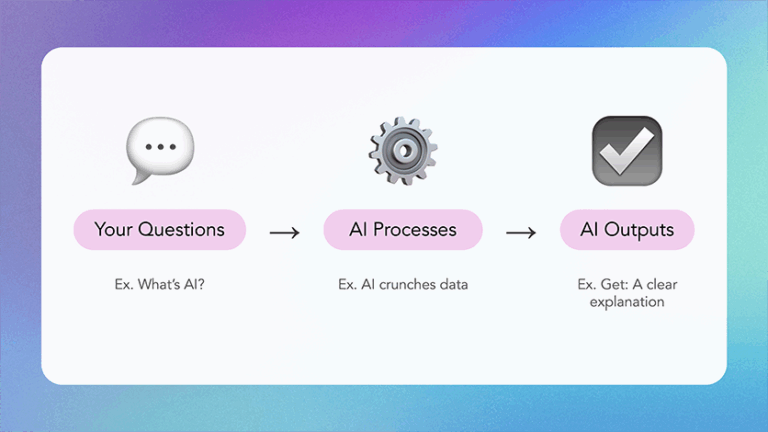
2. AI Processes (The Engine)
Once your question is received, the AI’s engine begins to work. This engine is made of two key components:
Algorithms: These are the rules and instructions that the AI follows. They are the code that gives AI its power to find patterns and connections in the data.
Learning: This is the “magic” of AI. The AI constantly uses a feedback loop to improve its own performance. It learns from its mistakes and updates its own rules to provide a better output next time.
3. AI Outputs (The Result)
The output is the helpful result you receive. It’s the finished dish from the kitchen—a clear explanation, a new idea, or a summary of a long document. These outputs are the final step in the process and are what make AI a powerful tool for professionals.
Why AI Matters for Professionals Today
AI isn’t just a tech trend. It’s becoming a core skill for the modern workplace. Professionals who understand AI can:
☑️ Save time on repetitive tasks.
☑️ Make faster, data-driven decisions.
☑️ Unlock new opportunities for creativity and strategy.
☑️ Get the expertise you need—on-demand.
Common Misconceptions About AI
| Myth | Reality | Why It Matters |
|---|---|---|
| You need to be technical to use AI | Modern AI understands natural language—plain-English prompts work | You don’t need to be technical—you just need to learn to communicate with AI effectivley. |
| AI will replace all jobs | AI augments tasks; people set goals and standards | Human + AI collaboration—automate the repeatable while you own strategy, judgment, and results. |
| AI is 100% accurate | Models can error or “hallucinate” | Treat AI as a draft—you verify facts and context to protect quality and trust. |
How to Start Using AI in Your Daily Work
Here’s a 3-step plan to start experimenting with AI without overwhelm:
- Pick one task (email, brainstorming, or summarizing notes).
- Use a simple AI tool (e.g., ChatGPT, Gemini, Claude, Grok).
- Reflect and adjust—was it helpful? What would you tweak?
Founder’s Note: From Satellites to Simplicity
As the founder of GeoThinkTank LLC with over 12 years supporting NASA and NOAA satellite programs, I learned that even the most complex systems can often be explained in clear, simple terms. The same is true for AI: you don’t need to know every detail—you just need to know how to effectively communication with AI to apply it to your goals.
That’s why aiThrive was built—to turn AI into your new superpower. Making it simple, accessible, and focused to deliver on real-world impact.
Key Takeaways
- AI is simply technology that learns from data to make predictions or decisions.
- You already use AI in daily life—think email, maps, and streaming.
- AI is a professional superpower, helping you save time and think strategically.
- Myths about AI hold people back; the truth is, it’s accessible to everyone.
- You can start small—with micro-wins that build confidence.
FAQs
Q: Do I need coding skills to use AI?
No. Modern AI tools are designed for professionals in every field, not just tech experts.
Q: Isn’t AI only for big tech?
No. Professionals, entrepreneurs, and small businesses get value from off-the-shelf tools. Understanding how to use AI levels the playing field with out huge budgets.
Q: Is AI safe to use for business tasks?
Yes, when used responsibly. Start with non-sensitive tasks like brainstorming, summarizing, or drafting.
Q: Will AI replace my job?
AI is best seen as a collaborator—helping you work faster, not replacing your unique skills.
Build AI confidence in 3–5 minutes a day
Ready to move from curiosity to confidence? Thrive with AI: Step One is built for busy professionals like you. With 24 micro-lessons (just 3–5 minutes each), you’ll get ready-to-use prompts and real-world wins—without the overwhelm.